Hair color
Partial, full, face frame or lowlights: map the color placement
Compare where brightness and depth sit on the head. Understand partial versus full highlights, face framing, lowlights and how placement shows when tied up.
Upkeep: Placement, starting color and desired contrast determine the service plan. Separate root work, tone refresh and changes to the lengths when discussing future appointments.
Effort is a planning estimate. The specific option and your routine change the commitment.
The starting point
Color placement answers where the change will appear. Partial and full describe the areas being worked on; highlights and lowlights describe lighter and darker pieces; a face frame concentrates attention at the front. None of these labels alone tells you the final contrast, price, service time or regrowth pattern.
Compare the visual directions
Concept references for shape and placement. Save the specific look you like and open its details. These are starting points for a consultation.
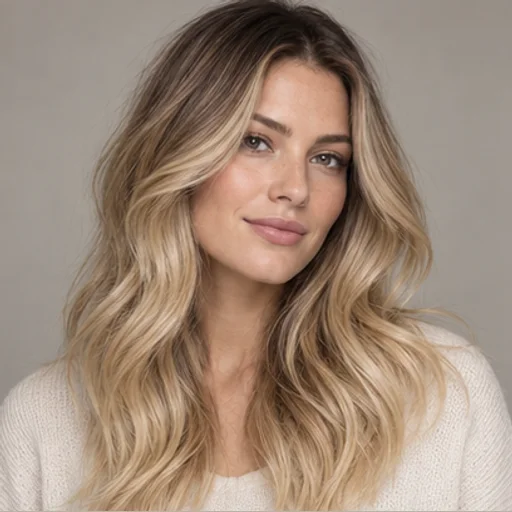
Fine highlights near the root
Narrow lighter pieces are distributed through the surface with brightness beginning high.
Styling effort varies · Long lengthDetails & styling for Fine highlights near the root
Choose it for: More dispersed lightness rather than a single broad panel or low gradient.
Think about: Fine sections can blend into an overall lighter impression. The photograph cannot prove which application method a stylist used.
A routine to discuss
- Map the service areas, including the underside.
- Ask how much natural or existing depth remains between the pieces.
Upkeep: Discuss visible new growth separately from tone changes in the lightened lengths.
Your salon request: I like fine distributed pieces beginning high, with ___ base depth still visible.
Use this look in my brief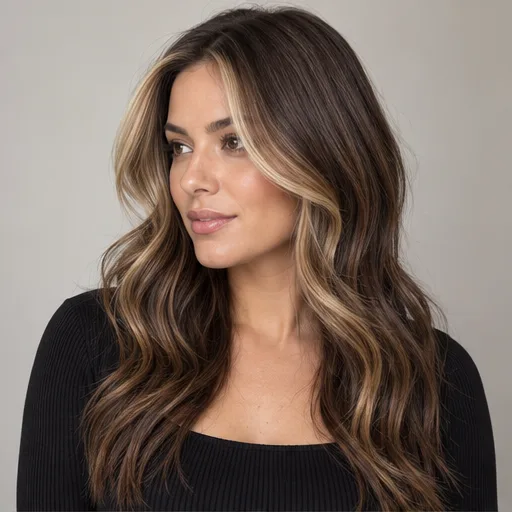
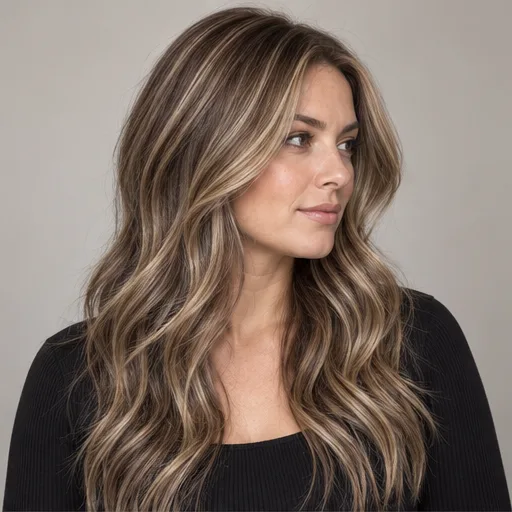
Brightness concentrated around the face
The most obvious lighter pieces sit beside the face rather than being equally distributed everywhere.
Styling effort varies · Long lengthDetails & styling for Brightness concentrated around the face
Choose it for: A front-focused change with a clear point of emphasis.
Think about: A broad money-piece effect differs from fine blended front highlights. Specify width and root proximity.
A routine to discuss
- Show your everyday part, fringe and ear tuck.
- Compare a narrow blend with a stronger border before approving the section.
Upkeep: The front root boundary can remain conspicuous even if little hair is colored.
Your salon request: I want the brightness at the front to be ___ wide and begin at ___, with more depth kept behind it.
Use this look in my brief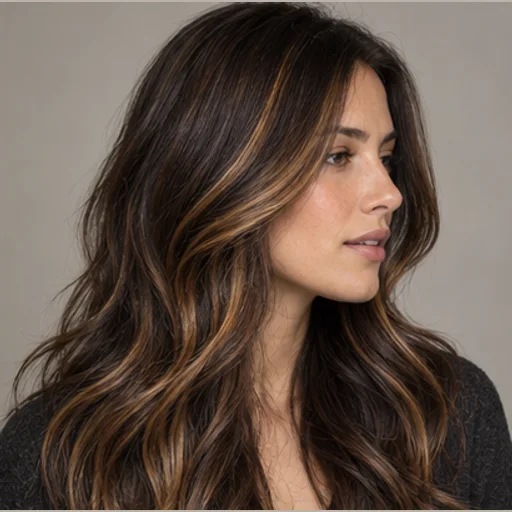
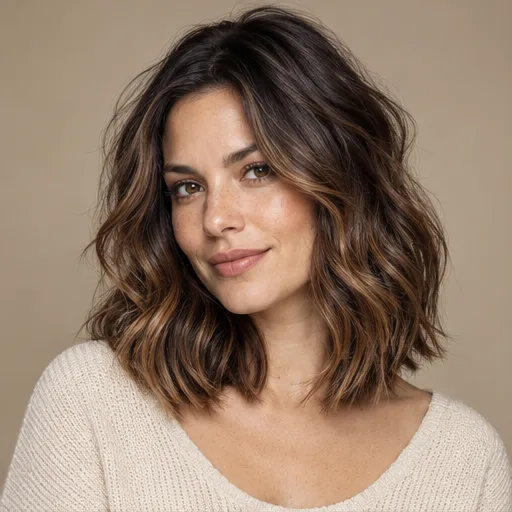
Caramel ribbons on a dark brunette base
Selected warm lighter ribbons remain separated by substantial dark hair.
Styling effort varies · Long lengthDetails & styling for Caramel ribbons on a dark brunette base
Choose it for: Brunette dimension that keeps the darker background visible.
Think about: Curl grouping and parting change which ribbons show. A full-head lighter result would be a different placement choice.
A routine to discuss
- Show the colorist your usual part and tie-back.
- Map the ribbon width and where each first bright section starts.
Upkeep: Maintain the desired contrast as well as the tone of the lighter pieces.
Your salon request: Keep most of my depth and place warm ribbons at ___, with this width rather than an overall blonde result.
Use this look in my brief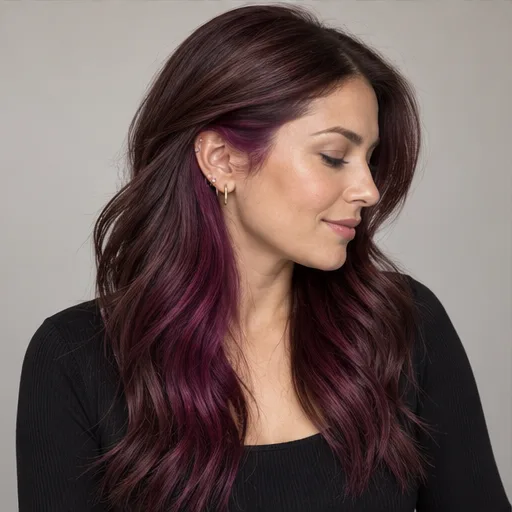
Plum panel within darker hair
A purple-toned section creates a local contrast while much of the darker base remains.
Styling effort varies · Medium lengthDetails & styling for Plum panel within darker hair
Choose it for: A defined area of vivid color rather than an all-over change.
Think about: The panel’s visibility changes when the hair is parted, tucked or tied. Pre-lightening requirements need individual assessment.
A routine to discuss
- Test the panel location in your normal down and gathered styles.
- Agree on the amount of contrast and the fade you would enjoy.
Upkeep: A small area still needs a tone and grow-out plan.
Your salon request: Put the plum emphasis at ___ and show what will be visible with my hair down and up.
Use this look in my brief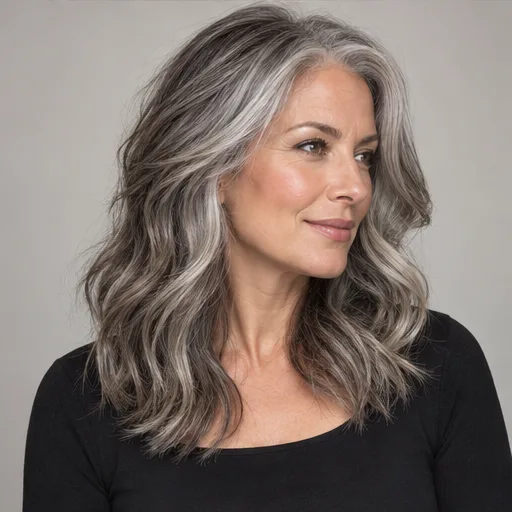
Gray and brunette dimension
Lighter gray-looking areas and darker pieces remain visible together in a medium-length shape.
Styling effort varies · Medium lengthDetails & styling for Gray and brunette dimension
Choose it for: A mixed light-and-dark impression rather than opaque uniform coverage.
Think about: A picture cannot tell which areas are natural or colored. Your own gray distribution and color history determine the route.
A routine to discuss
- State whether the destination is natural gray or an ongoing mixed-color design.
- Ask how each proposed service supports that destination.
Upkeep: Blending and full coverage create different future boundaries.
Your salon request: I like the mixture of light and depth. My destination is ___, and I want to understand each transition step.
Use this look in my briefCompare your options
Partial highlights
Selected areas are lightened while other areas retain more of the existing depth. Some services focus on the top and front, but the exact map differs by salon.
Ask about: Which sections are included, and what will the underside look like with my hair up?
Full highlights
Work is distributed around more of the head, including areas a partial service may leave untouched. Full does not necessarily mean every strand becomes light or that the result must be extremely blonde.
Ask about: How much of my base remains between the pieces, and where will the lightest areas be?
Face frame
Brightness is concentrated near the face. Fine pieces can blend in quietly; broader sections create a more graphic border. These are distinct versions of the same placement idea.
Ask about: How wide is the section, how near the root does it start and what happens around my usual part?
Lowlights
Selected darker pieces restore or add depth between lighter areas. This can change the apparent contrast without lightening more hair, but the suitable method depends on existing color.
Ask about: Which areas need depth, and how will the result look if I change my part?
Fine distributed ribbons
Narrow pieces create a more dispersed effect than broad panels. Their visibility changes with texture and how the hair separates.
Ask about: Will the pieces remain visible in my natural curl groups or blend into an overall lighter impression?
Broad panels or blocks
A larger section creates a deliberate contrast. An underside panel may be quieter with the hair down and more visible in a ponytail.
Ask about: Can we map exactly what is visible down, tucked and tied up?
Draw three views of the plan
Discuss front, side and back separately. Point out your normal part, fringe, face-framing layers and the areas exposed when you gather your hair. A placement that looks continuous in a down style can show an abrupt uncolored section when tied up; that may be intentional or a surprise.
Use your own daily styles during the consultation. Put the hair into your usual bun or ponytail and ask the colorist to show the sections that become visible. This is especially useful for short front layers, curly groupings and underlayer color.
Separate placement from application method
Foil and freehand application describe how the colorist works, while face framing and a partial map describe where. A salon may combine techniques to achieve the effect. Ask for a result map first and let the colorist explain the appropriate service.
A glossy reference may hide the placement when the hair is smoothed into one surface. Curls may group several differently colored strands into one visible ribbon. Look at references in a finish similar to the one you wear.
Plan the root boundary
Light pieces starting close to the scalp create a different visible grow-out from brightness beginning lower down. A darker root area may soften contrast, but it does not remove the need to discuss tone, existing color and future appointments.
Ask what you will see as natural hair grows through and which part of the service you can postpone if your budget or preference changes. Do not assume a partial appointment means low upkeep or a full appointment means constant root work.
Agree the feasible version
Bring your recent color and chemical-service history, including home products. A photograph cannot establish what the hair can tolerate or whether the change can happen in one visit. Large lightening changes require an individual assessment.
Follow the actual product’s precautions and testing directions. Previous uneventful use is not a promise of future tolerance; FDA consumer guidance is at fda.gov source. This guide compares design choices and does not provide lightener formulas or processing instructions.
Take this to your appointment
A starting point for your brief
I want lightness at ___ and depth kept at ___. I usually part and gather my hair like ___. Please show the front, underside and back placement, the expected root boundary and the maintenance choices.
Use this in my briefAdapt the wording to your own hair, preferences and history.
Common questions
Does partial mean half the result?
No. It describes a service area rather than a precise fraction of lightness. Ask which sections the salon includes and how they show in your normal style.
Are lowlights a way to undo all highlights?
They can add selected depth, but returning to a uniform darker result is a separate color assessment. Existing lightening and future plans affect the method.
Sources & further reading
Sources accessed 3 October 2026. These publishers have not reviewed this guide. Our editorial standards explain our method.